Events & Insights
The cell therapy CDMO landscape has undergone a significant reset. Following a peak of $8.2 billion in venture investment in 2021, funding decreased by more than 80% by 2024,1 leaving many contract manufacturers overextended and their facilities underutilized. Responses across the sector have included facility closures, strategic exits, workforce reductions, and client losses among some of the sector’s most recognized names.
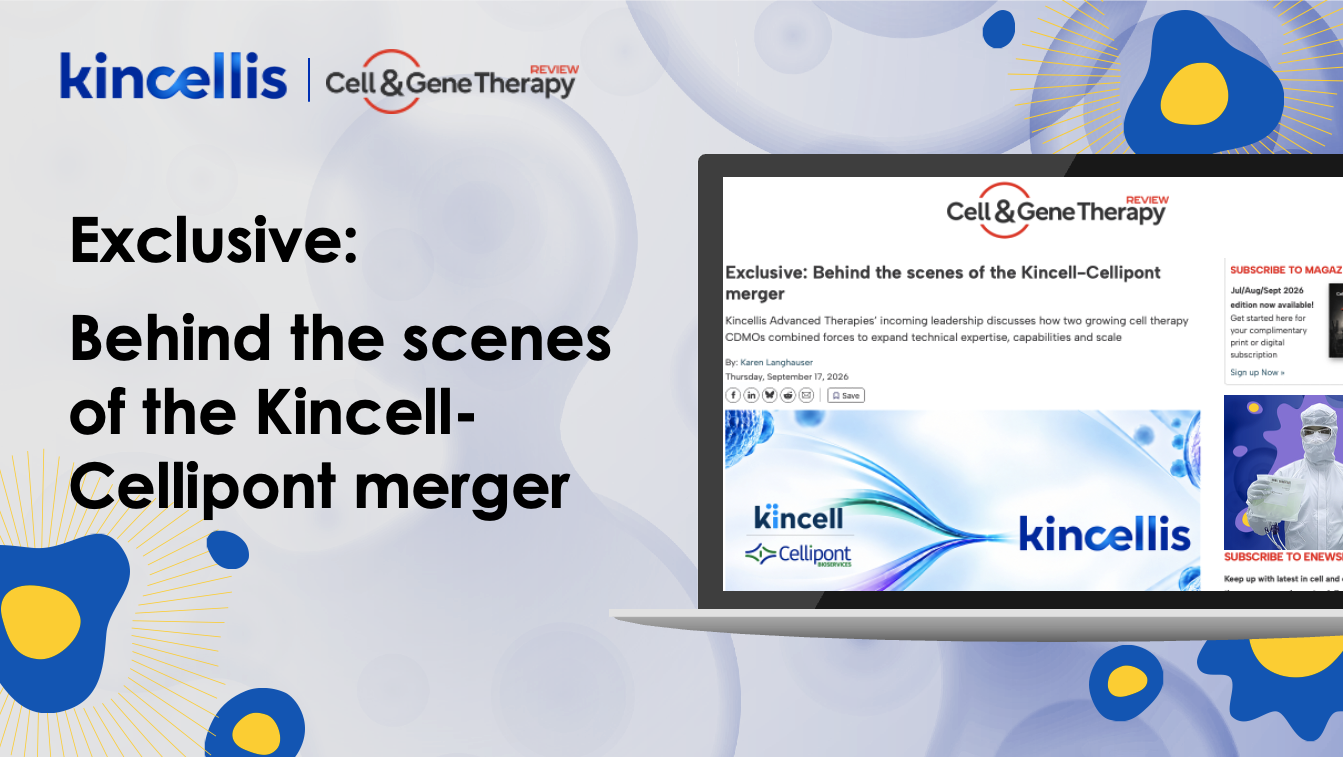
Kincell Bio is responding differently. While others have pulled back, Kincell Bio is making a significant investment to expand its Research Triangle Park, North Carolina, facility, enabling the addition of cleanrooms, laboratories, expanded warehouse capacity, and the digital infrastructure required to support programs advancing toward commercialization. It is a deliberate, forward-looking investment in the long-term promise of cell therapy and in Kincell’s clients working to deliver on that promise.
We sat down with key members of Kincell Bio’s leadership team, including Larry Pitcher, Chief Executive Officer, Bruce Thompson, PhD, President and Chief Technology Officer; Matt Haines, Chief Operations Officer; and Stewart McNaull, Chief Commercial Officer, to learn more about their thinking.
The cell therapy CDMO market has seen several high-profile pullbacks and exits recently. Why is Kincell Bio moving in the opposite direction?
Larry Pitcher: We are certainly behaving counter to many in the industry, but we see a sizeable opportunity to support clients and patients. While others are exiting, the need for high-quality cell therapy manufacturing has never been greater. Several of our lead clients are heading toward BLA filing. As they do, they will need more capacity, more late-stage capabilities, and a manufacturing partner fully prepared to support them. This expansion is our answer to that need. We are industrializing our facility in step with our clients’ progress. This is a strategic investment to support their evolving needs and the needs of additional customers we intend to serve from this site.
Matt Haines: From the outset, we designed our RTP facility with expansion in mind. The gray space was always there, waiting to be built out. We are simply executing on the master plan at the right time as our clients’ programs mature and our client base grows.
What does the expansion include, and how will the added capabilities and capacity allow you to serve Kincell’s clients?
Matt: The centerpiece of the physical expansion is enabling the addition of two ISO 7 cleanrooms, which will bring our total to six, meaningfully increasing our capacity to support both autologous and allogeneic programs at scale. Alongside the cleanrooms, we are building an MSAT lab, purpose-built for late-stage process characterization, validation, and technology transfer, which are capabilities that become increasingly critical as programs approach commercialization. We are also converting existing space into a dedicated microbiology lab, allowing us to bring rapid microbial and sterility testing fully in-house, eliminating an outsourcing dependency and accelerating release timelines, which matters greatly for autologous programs where time is a patient-critical factor. An additional quality control lab is being built; we are significantly expanding our GMP warehouse to increase storage capacity; and we are adding administrative space to accommodate a team of over 100.
The expansion also includes investments in digital infrastructure. Can you speak to that?
Matt: The physical build-out and the digital investment go hand in hand. We are making a large investment in our Veeva quality management system to expand its capabilities and enhance end-to-end visibility and control across our operations. We are also making a significant investment in our ERP system to support program and product management at scale. As more clients’ programs advance and batch volumes increase, you need the systems and infrastructure to match. These are not just operational improvements; they are the backbone of commercial readiness.
From a commercial perspective, what does this expansion mean for clients who are approaching the later stages of development?
Stewart McNaull: Especially for autologous programs, the RTP facility’s location is strategically important, making our expansion investments even more essential. The site is positioned to serve major hospital networks and clinical centers across the Mid-Atlantic and Northeast corridors, key markets with large patient populations and growing demand.
How does this expansion fit into Kincell Bio’s broader two-site strategy?
Bruce Thompson: The two sites work in sequence. Gainesville is our early-phase hub; the facility where new programs are onboarded, processes are developed, and clinical manufacturing begins. RTP is our center of excellence for late-phase supply, commercialization readiness, and eventually commercial manufacturing. As a client’s program matures, it moves through this continuum. The expansion of RTP is about ensuring that the back half of that journey is as well-equipped as the front half, creating a seamless path for clients from IND all the way through to commercial supply.
Matt: There is also real continuity in the transfer of programs as they move through their phases of development because our teams across both sites have strong relationships with one another and established working models. Tech transfer is often a source of anxiety in this industry, and I think we have done a lot to address it by ensuring strong relationships between our sites’ teams.
When will the RTP site expansion be complete, and what comes next?
Matt: The physical construction is on track with full occupancy targeted for late summer/early fall 2026. We are planning to celebrate with an open house for our clients, followed by a formal ribbon-cutting a few weeks later. The Veeva QMS implementation is already underway, and the ERP investment program will kick off shortly. By the end of 2026, we will have a facility that adds to the robust capabilities we already have.
Stewart: When I think about what comes next, I think about it in pretty straightforward terms. Our clients are preparing to deliver their therapies to patients. Our job is to make sure that when that moment comes, we are ready. This expansion is a meaningful step toward ensuring we can support our current clients as they move into the market and help additional innovators achieve their objectives.
In a market where many other cell therapy CDMOs are pulling back, what does this expansion signal about Kincell Bio’s overall strategy?
Larry: It signals conviction. We strongly believe in our clients, in the science, and in the long-term trajectory of the cell therapy sector. Specifically, we believe in the positive impact these therapies have on patients’ lives and their families. The entire Kincell organization is driven by the incredible impacts on human health, and these same positive clinical outcomes motivate the market at large to continue pressing forward.
Funding across the cell therapy sector has been tight, many programs slowed, and some CDMOs have understandably chosen to reduce their exposure. We looked at the same environment and made different strategic plans.
When Kincell was founded in 2023, we did not overinvest in late-phase and commercial capacity. We had sufficient capabilities in this area, yet we timed our investments to align with the stages of our customers’ programs, rather than overinvesting in capabilities our clients were not yet ready for, which would have risked Kincell Bio’s financial health.
However, several of our clients are now on a genuine path to commercialization. Our measured investment strategy has made us more than ready to meet the needs of these programs, while effectively managing our capital and balance sheet, allowing us to meet the cell therapy sector’s long-term needs and weather the shifting investment landscape we’ve seen over the last few years.
The RTP facility expansion is projected to be fully operational by late summer/early fall 2026. For questions about Kincell Bio’s capabilities, services, and our ability to serve your program, please contact us.
Sources:
- “Budget blues: where are cell and gene therapies heading?” Roohi Mariam Peter, September 17, 2025, Labiotech